Safari Adventures |
|||
Introduction |
|||
|
Safari – the essence of Africa conjured up in a single word. What other word can create a mental picture full of the sights and sounds that are pure Africa. To visit this continent and not take a safari is like eating fish and chips without the salt and vinegar, only half the enjoyment. It was Africa that re-kindled my desire to paint the natural world and still inspires me today even after more than 20 years. A continent that is full of great diversity and contrast both from people, wildlife and habitats. It contains many of the world’s greatest natural wonders boasting the highest free-standing volcano, the longest single curtain of water and is home to the worlds longest river. Africa is home to the largest and driest desert covering one fifth of the continent together with the most ancient at over 80 million years. The Great Rift Valley which stretches for 3,700 miles, can be seen from space- it is a truly awesome and unforgettable continent which has inspired many artists and adventurers for centuries. When Shakespeare wrote “ I speak of Africa and golden joys” his thoughts have been shared by many over the centuries. I hope the following extracts from my diaries will excite and inspire you to follow in their footsteps as I have. |
|||
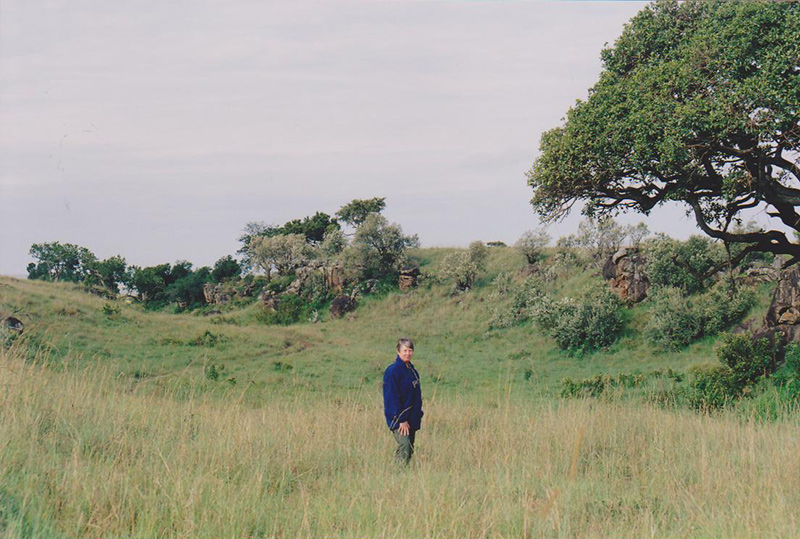
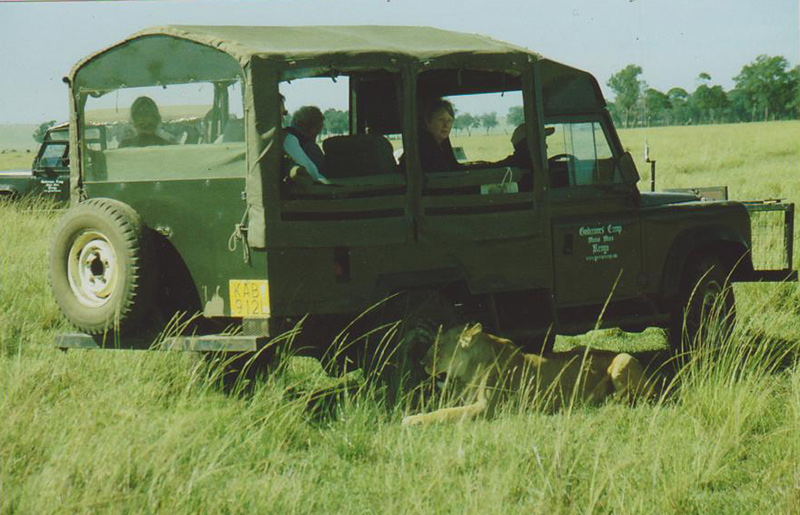
Adventures in Kenya“The Masai Mara is special at any time of the year but during the wildebeest migration it becomes spectacular.” “A balloon safari drifted overhead and the sound of it’s burners being fired sent the lionesses running into the tall, thick elephant grass which surrounded us. The ever increasing number of zebra and wildebeest gathering across the plains would ensure a plentiful supply of food for them and others. Among the large herds of zebra which congregated near the river were topi and impala, up to their bellies in grass the colour of ripening corn. On the horizon vast herds of wildebeest could be seen slowly edging their way towards the Mara river. Once they reach the river in their thousands and have nowhere to go but forward, then the real drama of the migration begins.”  MY BIG CAT MOMENT – reproduced in Wildscape & The Wildlife Art Society of Australasia magazine. She stood within inches of my hand. It would take only the slightest movement for me to stroke her tawny coloured back, yet caution and a sense of self-preservation made me sit quietly, hardly daring to breathe lest something should break the spell………….she stared out towards the plains searching for some movement, then she turned her head and our eyes met. For one brief moment I looked into the very soul of a wild lioness. I felt no fear only a mixture of excitement tinged with a slight apprehension -What if? – but there was no cause or concern. This was one of the Marsh Pride from the Masai Mara in Kenya made famous in Big Cat Diary with Jonathan Scott and Simon King. I was attending the 1st Annual Wildlife Festival, staying at Governors Camp on the banks of the Mara River. This was our third day spent enjoying numerous game drives, workshops and talks by a variety of wildlife specialists including the Scotts and David Shepherd. I had even sat painting at Leopard Gorge, sadly no leopards but this moment however, was very special and one to be savoured. Click to enlarge: 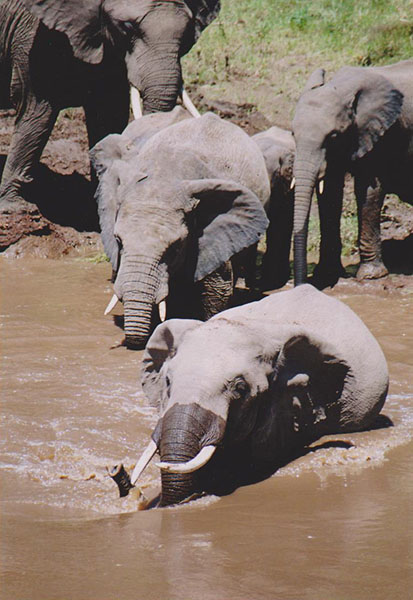
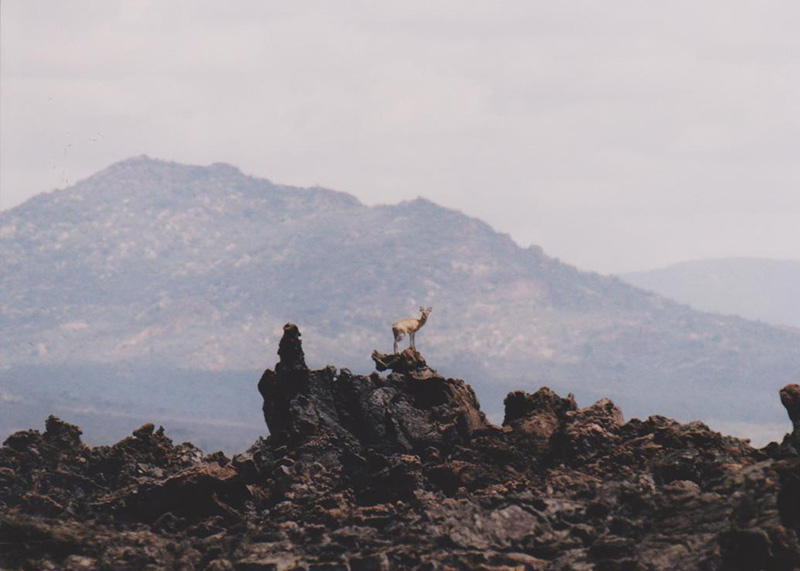
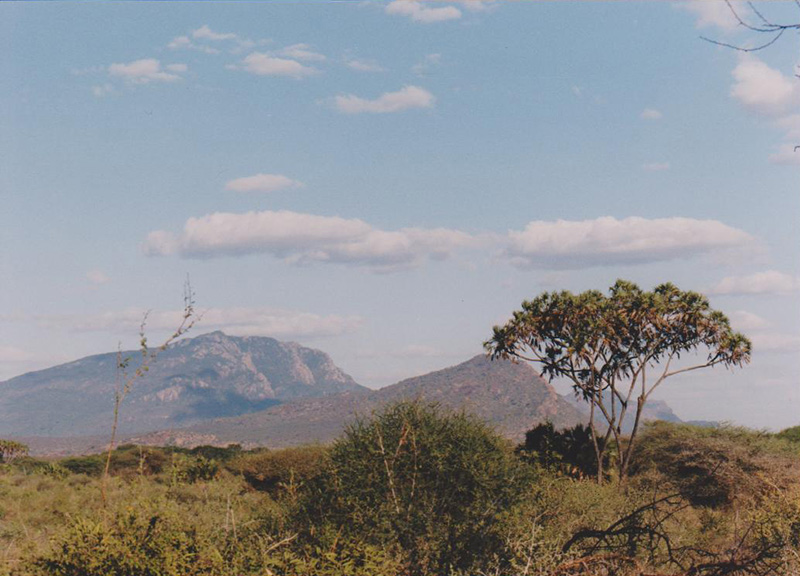
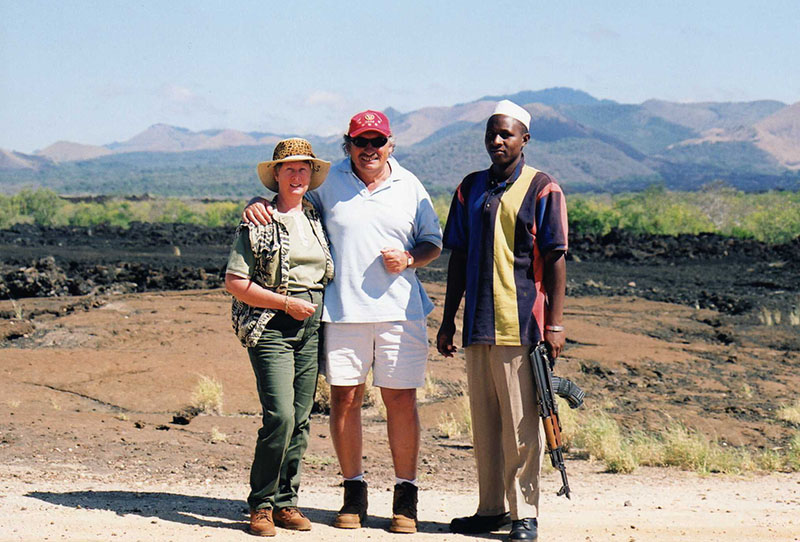
“TELL THEM I’LL BE IN TSAVO” – Words made famous by Denys Finch Hattons, whose love affair with Karen Blixen came to our screens in the film ‘Out of Africa’. Tsavo is indeed a spectacular place and one of the oldest National Parks in Kenya. Occupying an uninhabited area of over 8,000 sq. miles it is indeed colossal in size. Split into East and West by the Nairobi/Mombasa highway it provides two different and unique experiences. Generally East Tsavo is flat, hot and dry while the West is greener and hillier………. An unmissable experience is to spend time at Voi Lodge where you can get ‘up close & personal’ with the resident baboons and enjoy viewing large number of elephant from a hide, as they come from miles around to drink at the waterhole ……………. The Chyulu Hills in West Tsavo are the setting for a spectacular lava flow which occurred some 2-300 years ago, called the Shetani Lava Flow. Local legend has it that you can still hear the moaning of the people who died in the eruption but this is of course just the wind as it whistles through the porous lava rock caves. If your lucky you might even spot Klipspringers as they nimbly jump about the uneven, rocky ground, which is of course perfect for them……………On a clear day you might even see Mt. Kilimanjaro with it’s snow covered peak in the far distance. Click to enlarge: 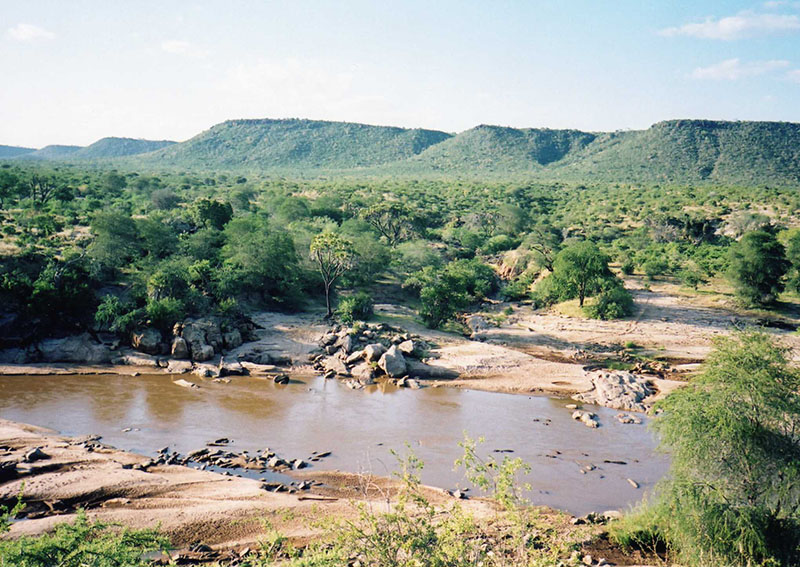
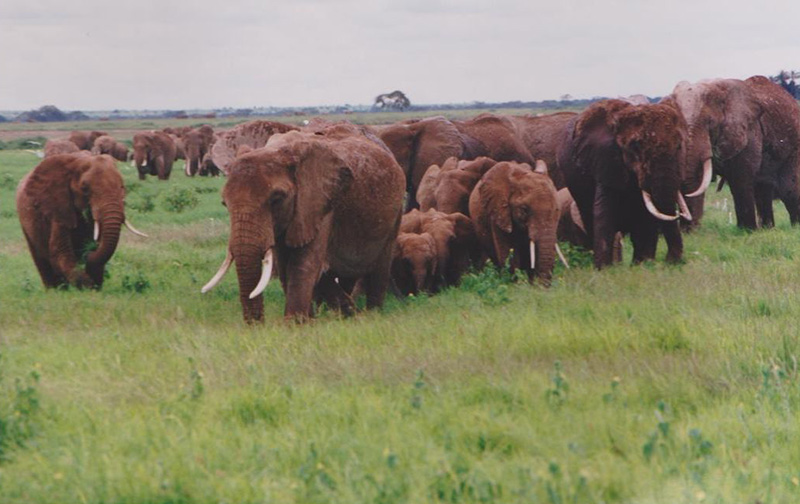
WASHED OUT IN AMBOSELI – Originally written & published as an article in Msafiri, Kenya Airways Inflight magazine. This was a safari that turned out to be different from any other in a variety of ways. For many months Kenya had experienced torrential rain, El Nino had been doing its worst. The drive from Nairobi to Namanga was relatively smooth but once off the tarmac and heading for Amboseli it was a different story. The main dirt road was treacherously muddy and in parts large areas had been washed away. The previous day the bridge that spans the Namanga river had been flooded and impossible to cross. The debris brought down by the flood waters lay in a tangled mass of roots and branches up against the side of the bridge. The brown muddy waters swirled and tumbled over the rocks and fallen trees like a giant cauldron of boiling liquid chocolate. This year we had chosen to take a 4WD Landcruiser which was to prove our best decision………… the huge expanse of Amboseli Lake became visible, now swollen with flood water extending for miles in each direction. The natural swamp, which remains throughout the year, had extended it’s boundaries and spilt out into much of the park creating a multitude of miniature lakes and causing some routes to become impassable. In the distance we could see a small group of vehicles (which turned out to be a film crew) and around them what appeared to be a group of elephants………not one group but a long line extended back almost as far as we could see heading steadily toward the swamp……..this was something very special…….we watched in silent amazement as this natural spectacle unfolded in front of our eyes…………how strangely silent it was considering the number of animals we were watching. The low rumbles of conversation and occasional trumpeting seemed only to re-emphasize the silence………upward of 150 elephants must have passed in front of us………what a magnificent sight with Mt. Kilimanjaro, shrouded in cloud, providing a spectacular backdrop in the distance. Click to enlarge: 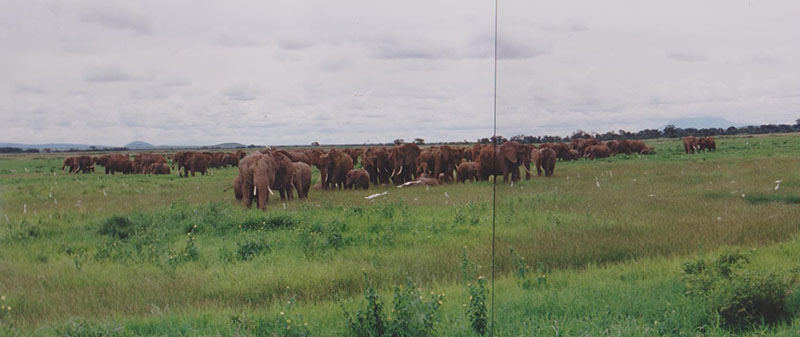

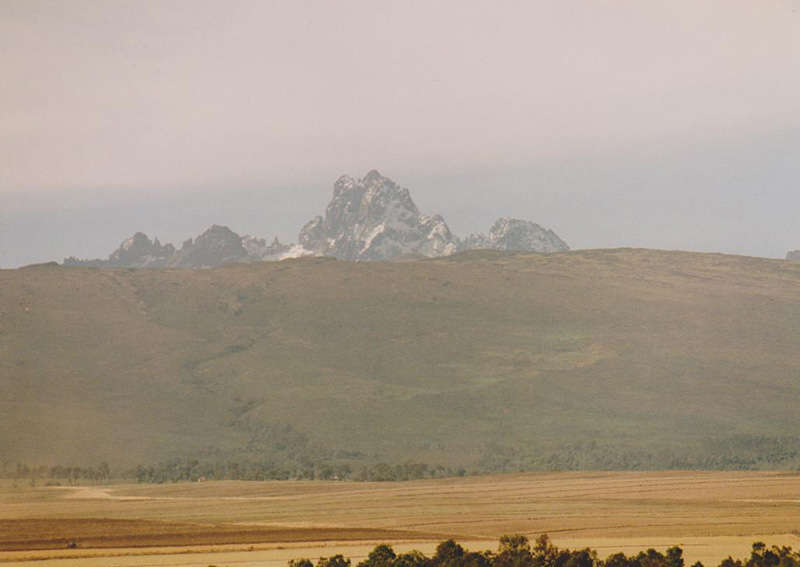
THE ARK TO SAMBURU – extracts from “Safari, the Diary of a Wildlife Artist.” It seemed as if we had only just fallen asleep, although in actual fact at least two hours had passed by, when we were woken from our slumbers by the buzzer sounding in our ears – something exciting must be at the waterhole... I looked out of the window into the darkness outside. Below, illuminated in the floodlights the distinctive shape of a female rhino and her calf. ‘Quick, quick’ I urged my husband as we stumbled around the room trying to get dressed………people were appearing from every direction, excited anticipation on their faces, clothes in disarray, camera’s at the ready……… As our driver had told us ‘ you don’t go to the Ark to sleep’ however, there were no more calls and soon our stay at the Ark was over. As the morning air began to warm up, the clouds which bathed Mt. Kenya like a filmy grey veil, slowly began to lift, eventually the snow clad upper slopes became visible, like a cake with icing on the top. Sitting on the equator, Mt. Kenya dominates the landscape for miles and many climbers are attracted to the rocky summit with its permanent glaciers and snow fields…………….. Pausing to photograph a Buffalo Weaver bird, proved a most fortuitous stop………..driving further down the road we were suddenly stopped dead in our tracks with a squeal of brakes and clouds of dust rising up behind us. Leaping out from the bush and seeming almost to clear the bonnet of our vehicle, a magnificent male Greater Kudu followed by three females and a calf………he was so large that he appeared to fill our windscreen as he cleared the road in a couple of bounds. Even our driver had not seen such a striking and beautiful Kudu in many years, coupled with their shy nature it was indeed a rare find………taking a side track we head off in the direction they had gone and wait………slowly but surely they come into view, feeding on tender leaves as they go…….soon they are in photo range and seemingly unperturbed by our presence……one hardly dares breathe let alone speak in case the spell is broken and they take flight again. Click to enlarge: 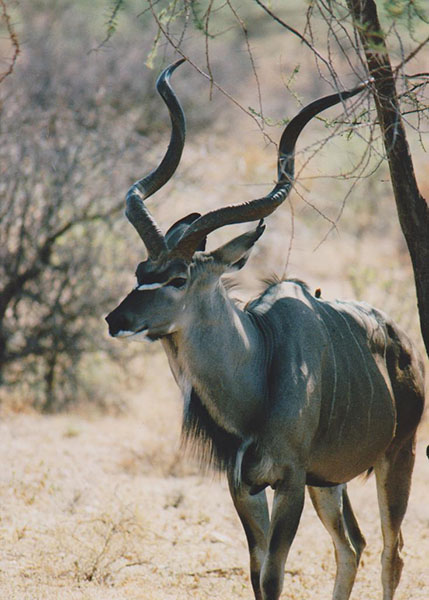

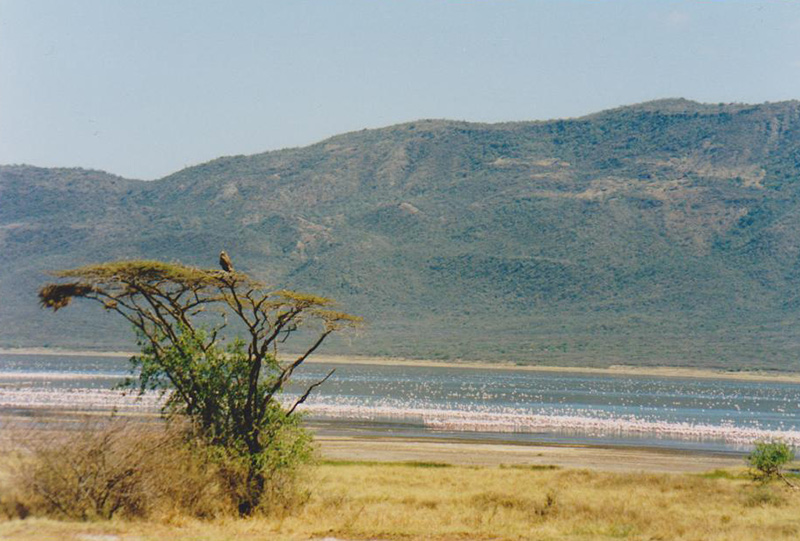
FLAMINGO LAKE – extract from “Safari, the Diary of a Wildlife Artist..” Lake Bogoria, lying some 175 miles north of Nairobi, is perhaps the least visited of the Rift Valley lakes and yet the most interesting with it’s hot springs located along the western shore. Some of the geysers can erupt to a height of 16-20 ft. but those around the area we visited were slightly less impressive but hot enough to boil an egg nonetheless so it was wise to keep ones distance! It was the lack of flamingos at Nakuru that had brought us to Lake Bogoria and we were not disappointed, with groups of varying sizes along the shore line and the largest near to the hot springs being tens, if not hundreds of thousands strong…………..it is the highly alkaline waters of the lake which attract the flamingos to feed on the abundant algae which grow in the warm brackish soda waters……….Unlike the other Rift Valley lakes, Bogoria had a greater wilderness feeling with the high Siracho Escarpement dominating the eastern shore……..Tawny & Fish Eagles were also present in large numbers, unfortunately they are partial to flamingo. Apart from the obvious attraction of the flamingos, the other memorable experience was swimming in the hotel pool which was warmed by the waters from hot springs below and was so green in colour that you couldn’t see the bottom!!! Click to enlarge: 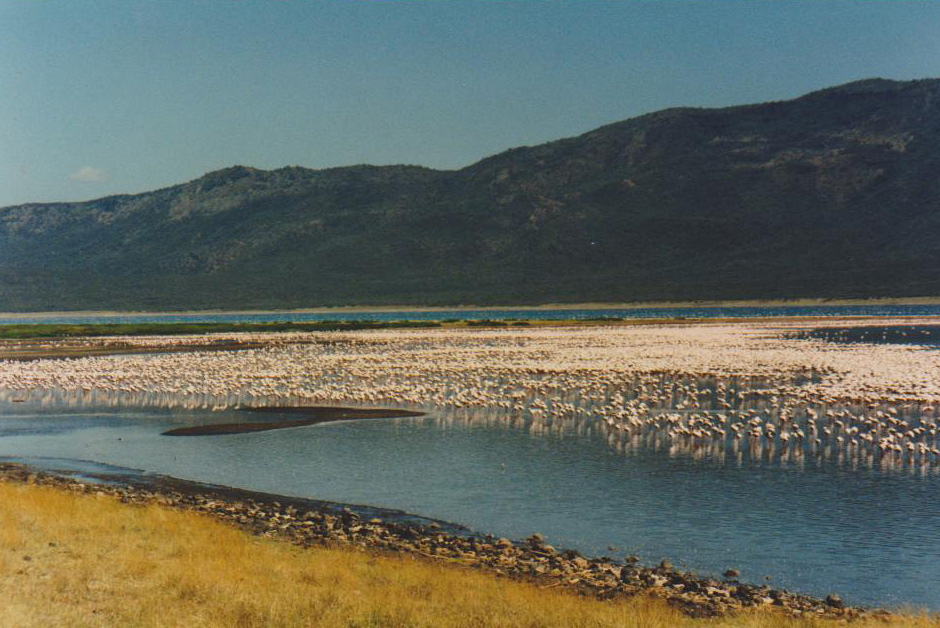
|
|||
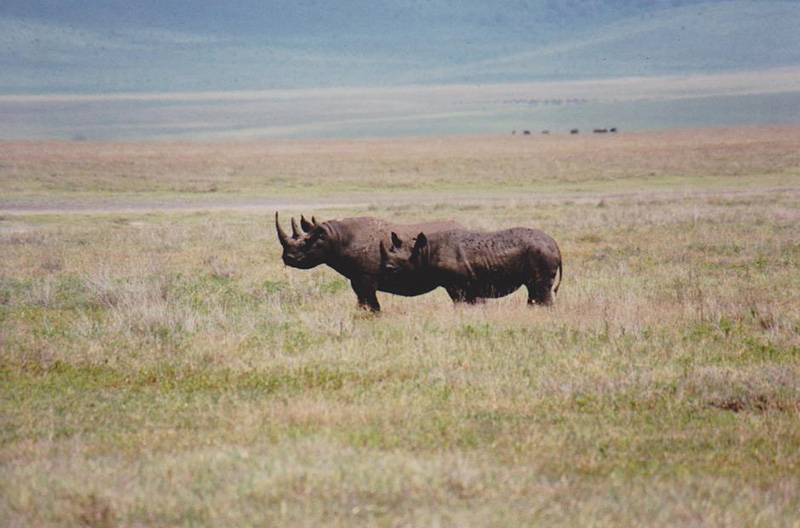
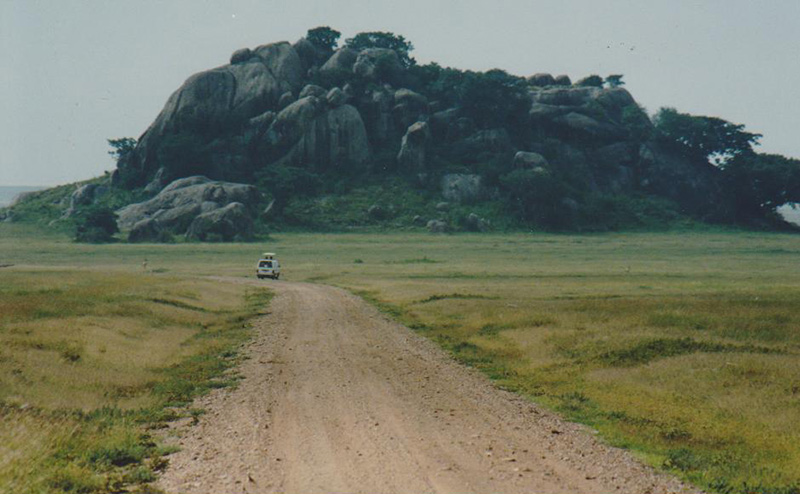
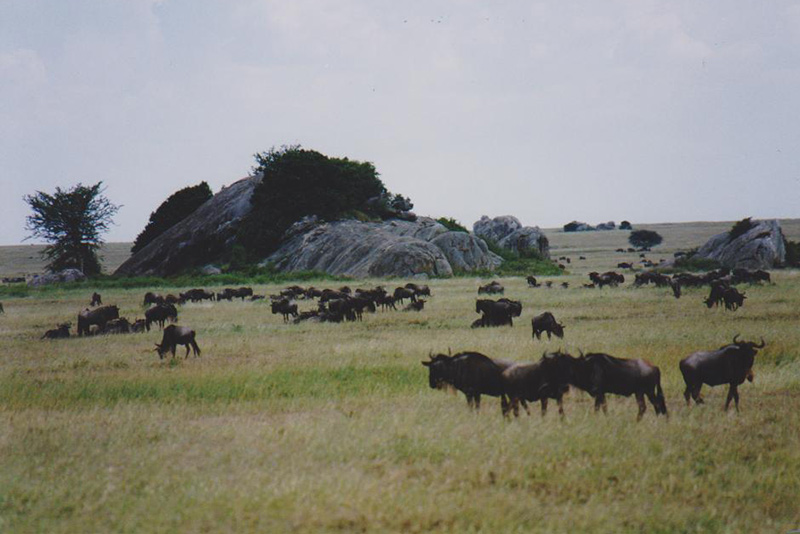
Travels in Tanzania-extracts from “Safari, Diary of a Wildlife Artist.”The Serengeti and Ngorongoro Crater – apart from the Masai Mara few other game reserves conjure up a picture of the African plains that is legendary. The crater was created by violent volcanic action 2-3 million years ago which resulted in the largest caldera in East Africa and the sixth largest in the world. Ngorongoro is like a microcosm of the wildlife of Africa and as such is completely unique. The slopes are lined with lush tropical rainforest leading down to the floor of the crater spreading out as rich green savannah teeming with life. Due to it’s position the crater provides a safe haven from poachers and we saw some of the largest tuskers we had ever seen. The Serengeti, along with the Masai Mara in Kenya, are famous for the migration of over 1.5 million Wildebeest who cross these plains in an endless search for fresh green grass. They follow the rain in a 1,000 mile trek which takes them 12 months to complete and during that time the Drama is re-enacted whenever they have to cross a crocodile filled river. This is what draws people back time and time again. One of the world’s greatest naturalists, George Schaller wrote of the Serengeti “ To witness that calm rhythm of life revives our worn souls and recaptures a feeling of belonging to the natural world. No-one can return from the Serengeti unchanged, for tawny lions will forever prowl our memory and great herds throng our imagination. After a two hour drive we enter the Serengeti Conservation area and are immediately confronted with the sight of Wildebeest as far as they eye can see. In the distance they look like tiny black ants, nothing in your imagination prepares you for this sight or the constant deep nasal sound as they communicate with one another. The highlight of our morning was finding seven cheetah’s – two singly, then a mother with a month old cub. Later we found another mother with two fully grown cubs on their way to hunt. The sight of these beautiful creatures at such close quarters is an amazing experience. Click to enlarge: 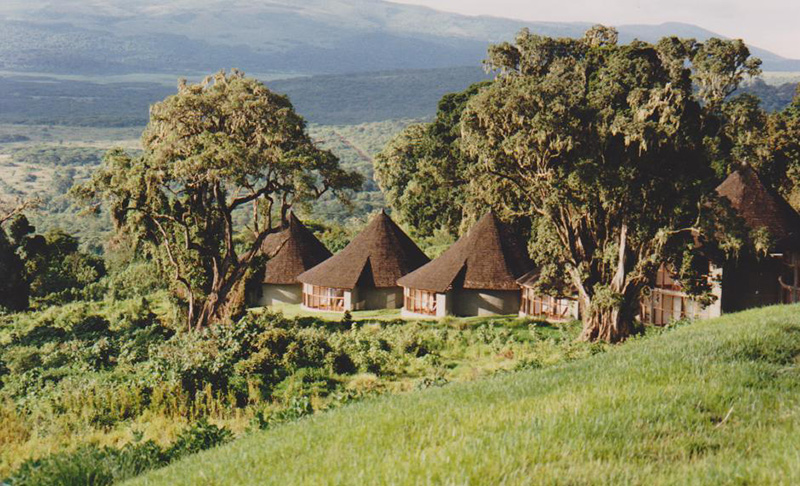
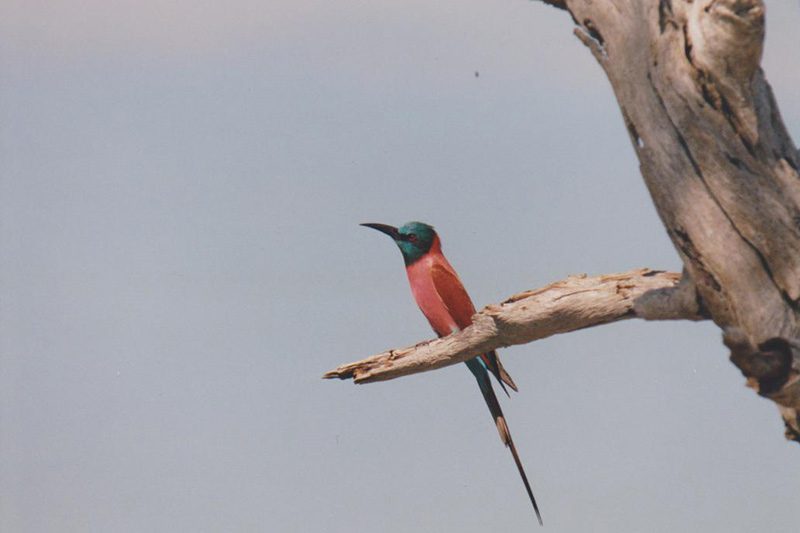
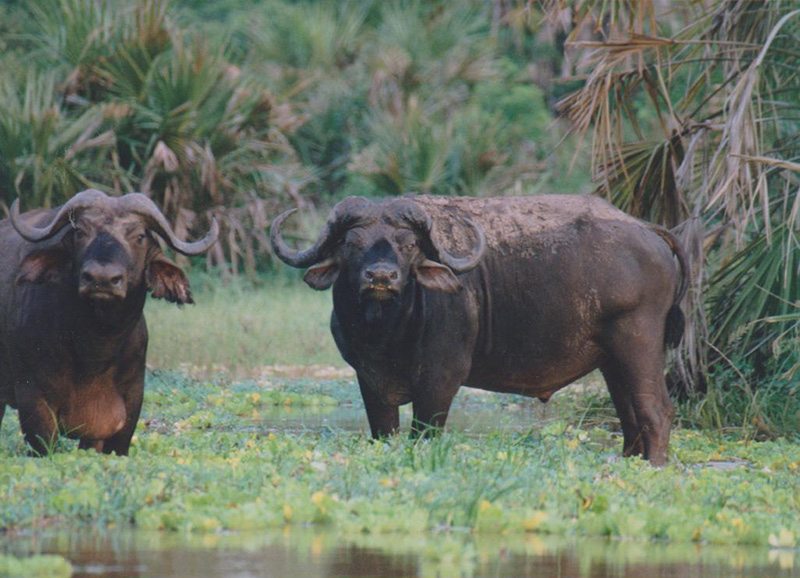
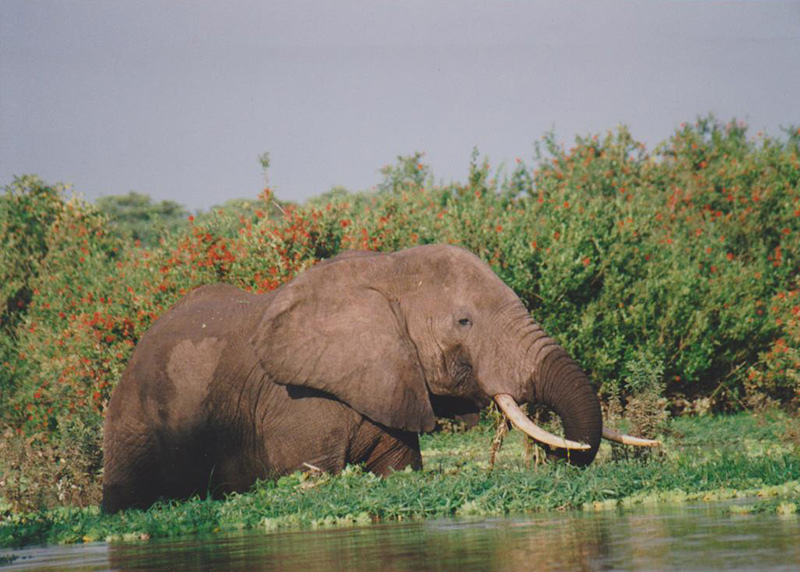
The Selous is Africa’s largest and wildest game reserve and due to it’s unique ecological importance, became a ‘World Heritage’ site in 1982. The absence of mass tourism contributes to the spectacular concentrations of wildlife and a pristine wilderness in an area of around 45,000 sq.km. being bigger than Switzerland or Denmark. We stayed at a camp on the Rufiji River and enjoyed numerous boat safari’s which offer a very different view of the wildlife from elephants crossing the river to banks of Carmine Bee-eaters being raided by a Monitor Lizard………. The huge Borassus Palms, towering up to 80 feet provided great vantage points for the African Fish Eagles. Herons, Egrets, Kingfishers, Storks and Bee-eaters were our constant companions as we explored the river and the many lakes formed by the swollen waters which spilled out far beyond the rivers banks. Along these vast waterways we regularly came upon Buffalo, Hippo’s and crocodiles…… It was in the Selous that we experienced our first game walk when you have the chance to ‘get up close and personal’ with the wildlife. Animals generally try to avoid human contact but it is still necessary to have the security of an armed guard. When you have a herd of elephants browsing only a few hundred yards away, an armed guard is quite a comfort!!!”…. As our camp was open to the bush it was possible for animals to wander through at any time……….on one occasion I was walking towards the viewing platform overlooking part of the river when I realised that an elephant was browsing just a few feet away…….it meant I was unable to walk further and the people on the platform were marooned until he decided to move away which was not for quite some time……it was lucky I spotted the elephant because I could so easily have walked straight into him as I am often looking up into the trees for interesting birds. I think there’s a lesson there somewhere. All together the Selous provided us with many unique and memorable experiences, seeing wildlife from a completely different angle. Click to enlarge: 
|
|||
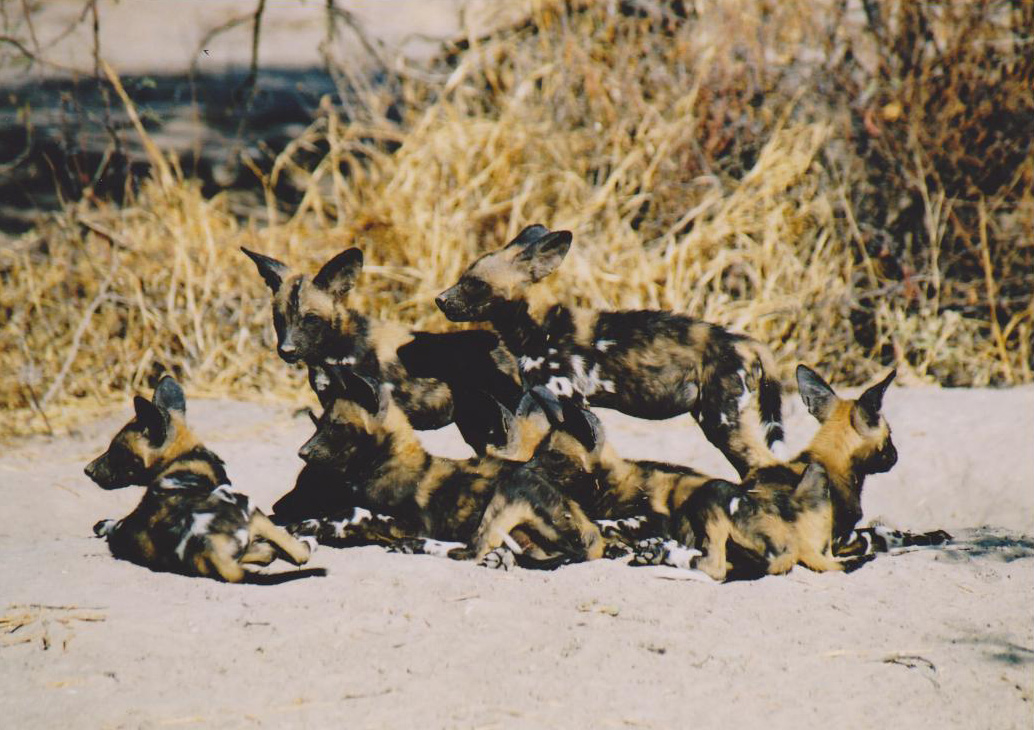
A Botswana ExperienceWILD DOGS OF THE OKAVANGO – Published in the Wildscape magazine. The Okavango Delta in Botswana, Africa’s last true wilderness, an enchanted oasis, one of the world’s greatest wetlands, a Garden of Eden – it is all of these and more. Surrounded by the Kalahari Desert, the fact that it exists at all is a miracle of nature. This is home to the African wild dog, one of the few remaining refuges left to this most endangered of the continents larger carnivores. It was now mid-day and extremely hot. Many times in Kenya we have been stuck in the mud but here it was sand, deep shifting sand. The more our 4x4 tried to drive out of it, the deeper it went down……..were we fated never to see these wild dogs………eventually re-enforcements arrived and after almost two hours we set off once more………..perfectly camouflaged in the dappled shade, sleeping in the sand among dead branches, lay four adult wild dogs, two male and two female……… he made his way towards the den and as he approached an entrance hole, out tumbled eight little puppies as though on cue………………… Through a dreamy haze I became aware of the distant evocative sound of a horn and tribal drums – it was 6am and camp wake up call, We were off to see the wild dogs again…………..those first few moments of excited greeting as the adults returned and the pups continued to beg for food……….….at this stage of their development, life is a game of discovery and full if innocent curiosity, the serious business of survival would come soon enough but for now they could enjoy the unbridled pleasure of puppyhood. Click to enlarge: 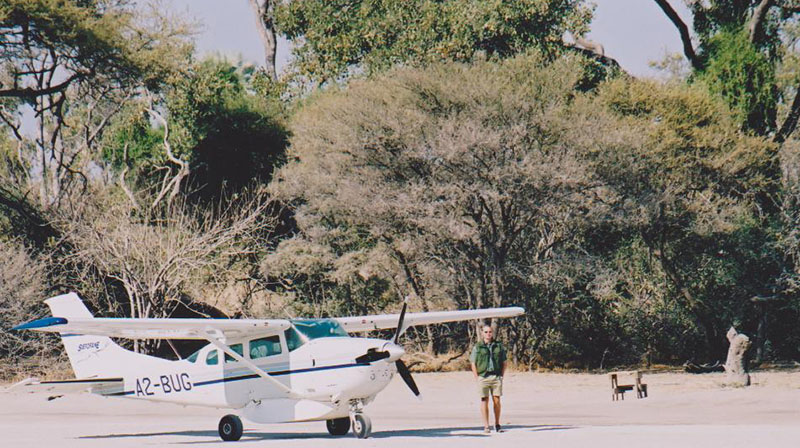
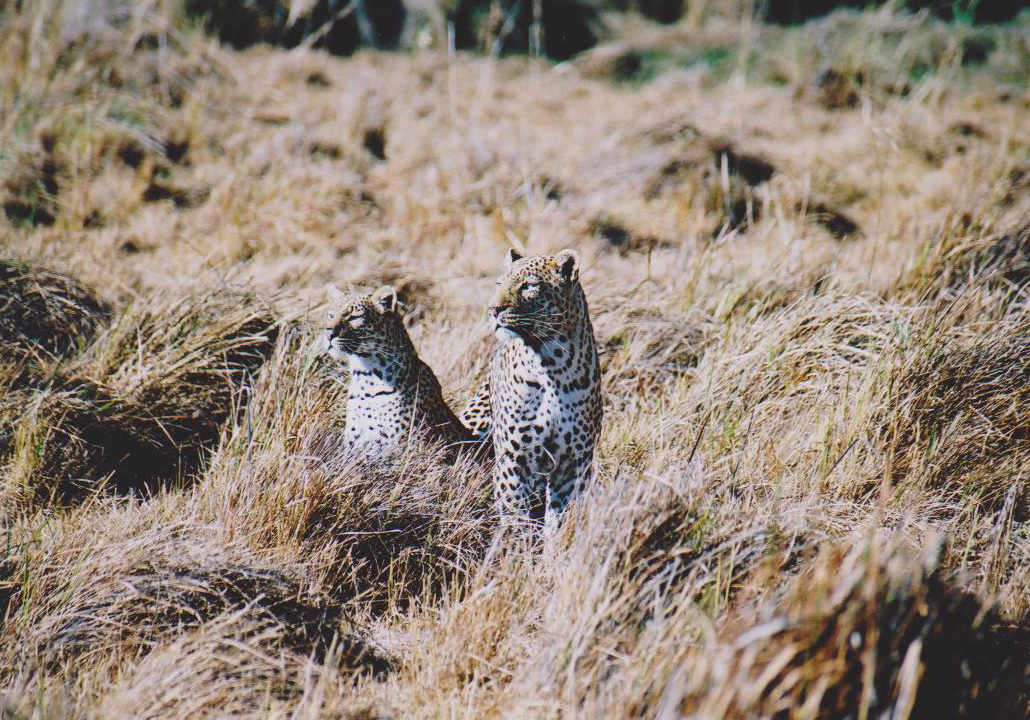
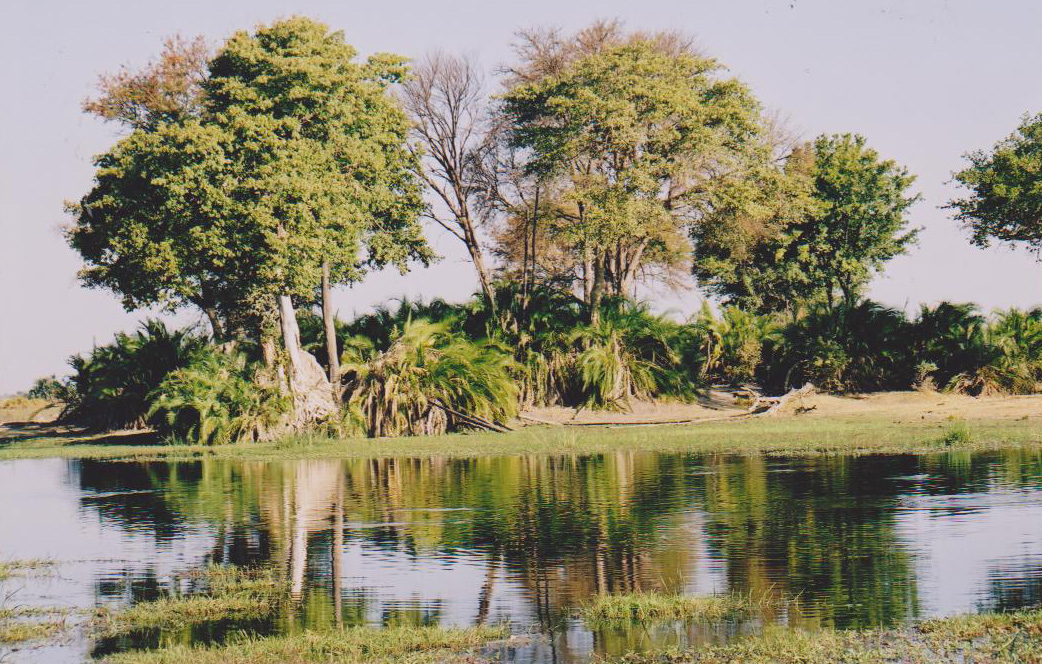

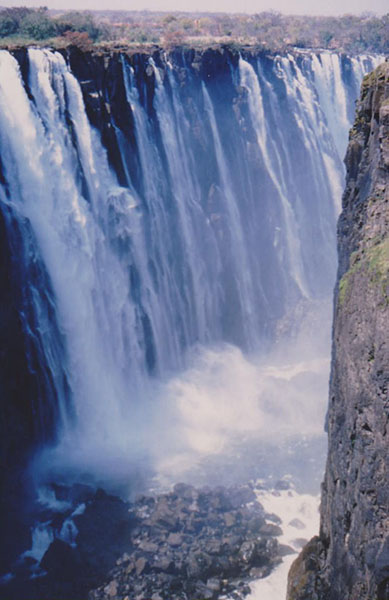
Leopards at last! We were about to have only our second close encounter with leopards in all our years of safari travels but this was to be something extra special. The first time we found leopards had been some years before in Samburu, Kenya when we had thought ourselves very lucky at the time……………what we were about to see was probably a ‘once in a lifetime experience’ that we would never witness again, for we had found a mating pair of leopards. Secretive and difficult to find at the best of times, here we had a male and female, out in the open not hidden from view and apparently oblivious to our presence. If they knew we were there, and I’m sure they did, they were completely unconcerned…………..we watched them for over an hour before leaving them to their ‘love-making’………..even our driver was surprised and remarked on how privileged we had been. Botswana had indeed been very special not just from our wildlife encounters but the scenery was different from anything else we had seen in Africa, especially the magic of the Okavango Delta. Unlike Kenya or parts of Tanzania, you could travel all day and not see another soul, you were alone with nature in all it’s beauty and drama. Elephant Back in Zimbabwe. Our brief trip into Zimbabwe was to see Victoria Falls as we were relatively close at the end of our safari to the Okavango. The Falls are a once in a lifetime, must see experience, which will leave you breathless at the sheer awe inspiring spectacle. One feels insignificant against such a power of nature, no wonder it is called ‘The Smoke that Thunders’ when the mist cloud created can be seen up to 50 miles away and the roar is heard even 12 miles away. Our visit took place in August but when the Falls are in full flood ( December- March) the sight must be almost unbelievable with water cascading over the edge at a rate of 2 million gallons per second, plummeting 330 feet to the gorge below. It is the largest curtain of falling water in the world, being 1.25 miles wide, and the experience will live with me until I breathe my last. Before returning to the U.K. we were to enjoy a game drive on elephant back at our overnight camp. The elephants had all been rescued or orphaned and now formed a new family who seemed quite amenable to having humans riding on their backs. Our African mahouts sat behind their ears just like the Indian version and we climbed a special platform to sit on the saddle………..viewing the bush from such a high vantage point, swaying gently from side to side was quite relaxing and the wildlife took no notice at all…………going uphill or down was tricky, in order to avoid falling off you needed to lean the opposite way…….I wish it was possible to do all game viewing on elephant back, it is quieter, more natural and so peaceful. Click to enlarge: 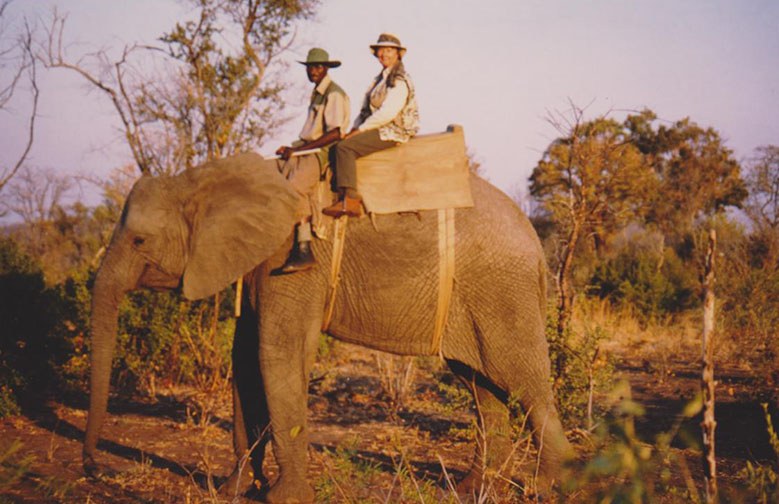
My safari travels in Africa have given me many memorable experiences and I never tire of visiting that vast and diverse continent year after year. Each time I say ‘Kwaheri’ I know I shall return, the distant drums will call me back with the beat and rhythm that is the life of Africa. |
|||
 |
|||